
Step 01 — Discovery of the first zone
Where the player reuses what was learned in the tutorial and understands all the mechanics that will be used throughout the level.
Emotion(s): Curiosity, Observation, Accomplishment
A Unity level design exercise built from the original Babbles source code, focused on creating a new map that respects the identity of the base game while delivering a clear emotional progression.
Babbles - Gamagora Edition was created as part of a course dedicated to Level Design. Thanks to Alexis Martelli, we had the opportunity to work from the source code of the original game developed by StarFish Studio.
The exercise was organized as a duo: each designer created their own level while keeping continuity between both maps.
Level objective:
My goal was to propose a clear and contrasted progression while creating varied emotions during the discovery of the map.
The first part of the level works as a reappropriation zone where the player reuses mechanics introduced in the tutorial. The second part opens into the identity of Babbles: exploration, contemplation, scale contrast, and a strong feeling of smallness in relation to the environment.
Initial paper concept -> production map:
The early layout helped define the first structure, while the production layout clarified the route, jumps, objectives, collectibles, hazards, and emotional progression.
Reference work:
I created this moodboard after defining the level direction, to feed the visual identity of the map: underwater spaces, scale contrast, shipwreck silhouettes, bright aquatic vegetation, and large vertical environments.
These references helped shape the intended emotional arc: curiosity, contemplation, awe, exploration, and the feeling of being very small inside a much larger world.
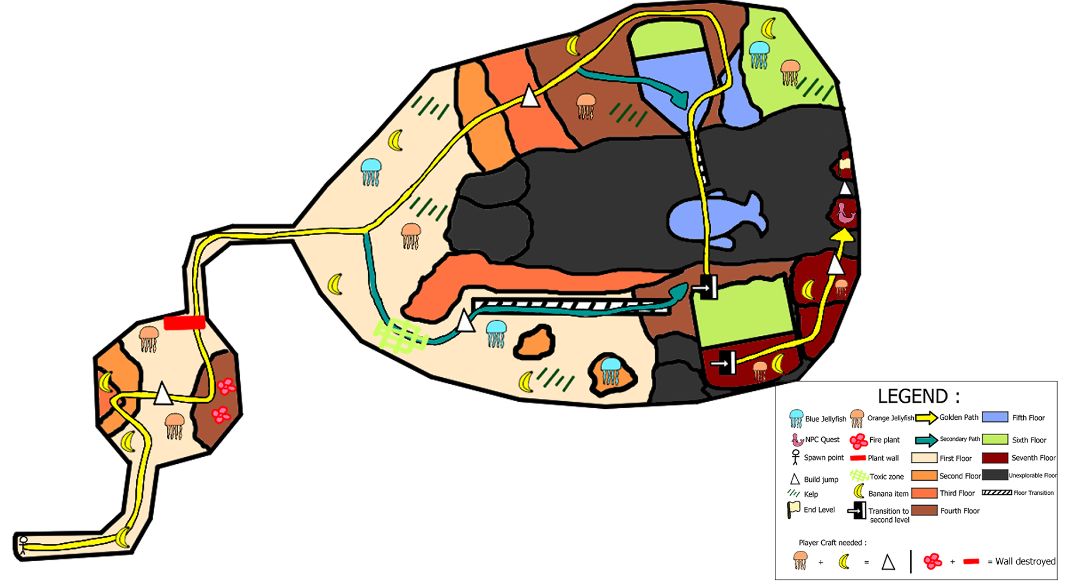
Click the numbered zones on the production map to highlight the corresponding intention below.
Where the player reuses what was learned in the tutorial and understands all the mechanics that will be used throughout the level.
Emotion(s): Curiosity, Observation, Accomplishment
After the first zone, the player goes through a deep chasm.
Emotion(s): Claustrophobia, Impatience, Interrogation
When the player leaves the deep chasm, he is welcomed by a strong "wow" effect as he discovers the widest part of the level. This creates a huge contrast with the previous zone, enhanced by the lighting, the color palette used in this area, and the presence of massive shipwrecks. He also sees his main goal, where he should go.
Emotion(s): Awe, Sense of Freedom, Exploration, Feeling of smallness
After exploring the area and moving through the shipwrecks, the player reaches the end of the level after a sequence of jumps.
Emotion(s): Sense of Height, Accomplishment
This breakdown compares the raw blockout screenshots with the annotated level design intentions. The annotations show how I used routes, affordances, lighting, and secondary paths to guide the player while keeping exploration readable.
Global view of the level, structured around a Golden Path and a Second Path. Lighting and landmarks subtly guide the player toward the final objective.
The first zone reintroduces the key mechanics of the level, notably bumper crafting. Framing and composition clearly indicate the objective to reach.
After the pinch point, the player discovers the entire explorable area. Leading lines naturally guide the player's gaze toward the final objective.
The main path is guided by wooden planks and corals, forming subtle indications. Lighting reinforces this guidance without breaking immersion.
Even along the classic path, the Golden Path remains readable while keeping the player inside the natural rhythm of the level.
Shortcuts are present and reinforce the identity of Babbles by encouraging exploration.
An alternative path, more risky, offers a shortcut to the player. Pollution, represented by a green cube, establishes a risk / reward logic.
The right shortcut is accessible using a bumper, requiring a crafting phase. It highlights the core gameplay of Babbles: exploration and crafting. Both lower paths converge toward the second ship. After crossing it, the player finishes the level through a platforming sequence using the bumper, leading to the end of the level I designed and toward the continuation of the game.
After three playtests, I realized that the guidance I originally intended was not always clear to players. The route shown below was my initial design intention, but feedback revealed that some players did not naturally read it as expected. By iterating on the composition, sightlines, and route information, the intended path became clearer in the final playtests, which confirmed that the playtest-driven changes were effective.
This section compares the readable blockout version with the later polish pass. The objective was not only to make the level prettier, but to support readability, atmosphere, scale, and the emotional progression defined during pre-production.
I started using assets quite early in the blockout to make some areas visually appealing before testing the level enough with other people. In this project it did not create a major production issue, but it made me realize how risky this can become in a larger pipeline if the level art progresses faster than the quality of the level design.
This project made me more aware of how important playtests are in level design. A layout can look clear to the designer, but the real test is whether players understand the intended route, read the affordances, and succeed without being over-directed.
Going forward, I want to be more disciplined with blockout validation: assets should be introduced when they support readability, intention, atmosphere, or player guidance, not simply because they make an area look better too early.